Hydrogen Gas Monitoring Applications in Battery Rooms
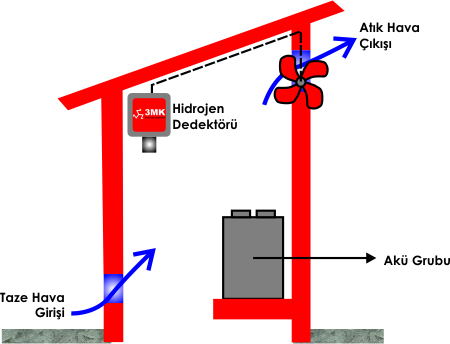
The battery rooms in premises are always under explosion risk as batteries release hydrogen during charging. Hydrogen is a highly explosive gas and it is therefore important to take necessary steps or actions for early warning in case of any hydrogen gas presence.
Hydrogen detectors supplied by Furkan Engineering offer flexible deployment. They can be used as a standalone system or integrated into an existing fire alarm or gas alarm system. Hydrogen sensors provide a 4–20mA output and can measure H₂ concentration as 0–100% LEL. Thanks to the 4–20mA output, the detector can be connected to PLC automation panels or gas control panels.
If you do not have any gas control panel, hydrogen gas detectors can still be used as a standalone gas alarm system by using an optional relay output card. The relay output card can activate a remote exhaust fan and/or alarm devices.
Hydrogen Gas and Effects

Hydrogen gas is colorless and odorless, and is lighter than air, causing the gas to rise to the top of a building.
Explosion Risk in Battery Rooms

The concentration of hydrogen in the air should be kept below 1% to reduce risk of explosion.
In practical applications, this typically requires a combination of continuous ventilation strategy and hydrogen gas monitoring, where the detector can control exhaust fans and trigger alerts based on predefined thresholds.
Hydrogen Gas Alarm and Monitoring System Applications
Hydrogen Gas Detector Integration with Ventilation

In this application, if hydrogen gas rate in the room reaches a preset level, exhaust fans will be turned on by the hydrogen gas detector. When the gas level turns back to below the preset level, exhaust fans will be automatically turned off. This enables maintaining stable air quality and keeping hydrogen density at safer levels.
Hydrogen Gas Detector + Ventilation Systems + Audible & Visual Alarm Device

- Hydrogen gas sensors can be integrated with different devices using 2 or 3 relay output modules. These outputs can react at different gas levels or send signals to third-party systems (e.g., fire alarm systems).
- In a typical 2-relay setup, the detector starts ventilation at the 1st gas threshold level to prevent ambient hydrogen density from reaching explosive levels.
- If ventilation is insufficient for any reason and the hydrogen level exceeds Level 1 and reaches the dangerous explosive threshold of Level 2, audible and visual warning devices are activated to inform emergency officers.
Hydrogen Gas Detector + Ventilation System + Visual/Audible Alarm + Phone Notification

- Hydrogen gas sensors can be integrated with different devices using 2 or 3 relay output modules to react at multiple thresholds or provide dry-contact outputs to third-party systems.
- In a 3-relay setup, the detector can run ventilation at the 1st threshold level and activate sound/light warning at the 2nd threshold level.
- Status notifications can be sent via PSTN landline call modules or GSM telephone call modules, especially in environments where personnel may not hear sirens.
Hydrogen Gas Detector + Ventilation System + Fire Alarm Integration

- Using NO/NC dry contact outputs, hydrogen gas monitoring can be integrated into conventional fire alarm systems, robbery alarm systems, or other automation platforms.
- This approach is especially useful when the battery charging station is close to a central fire alarm system and you need centralized alarming and monitoring.
